


Death of James B. McPherson Memorial
Georgia Historical Society
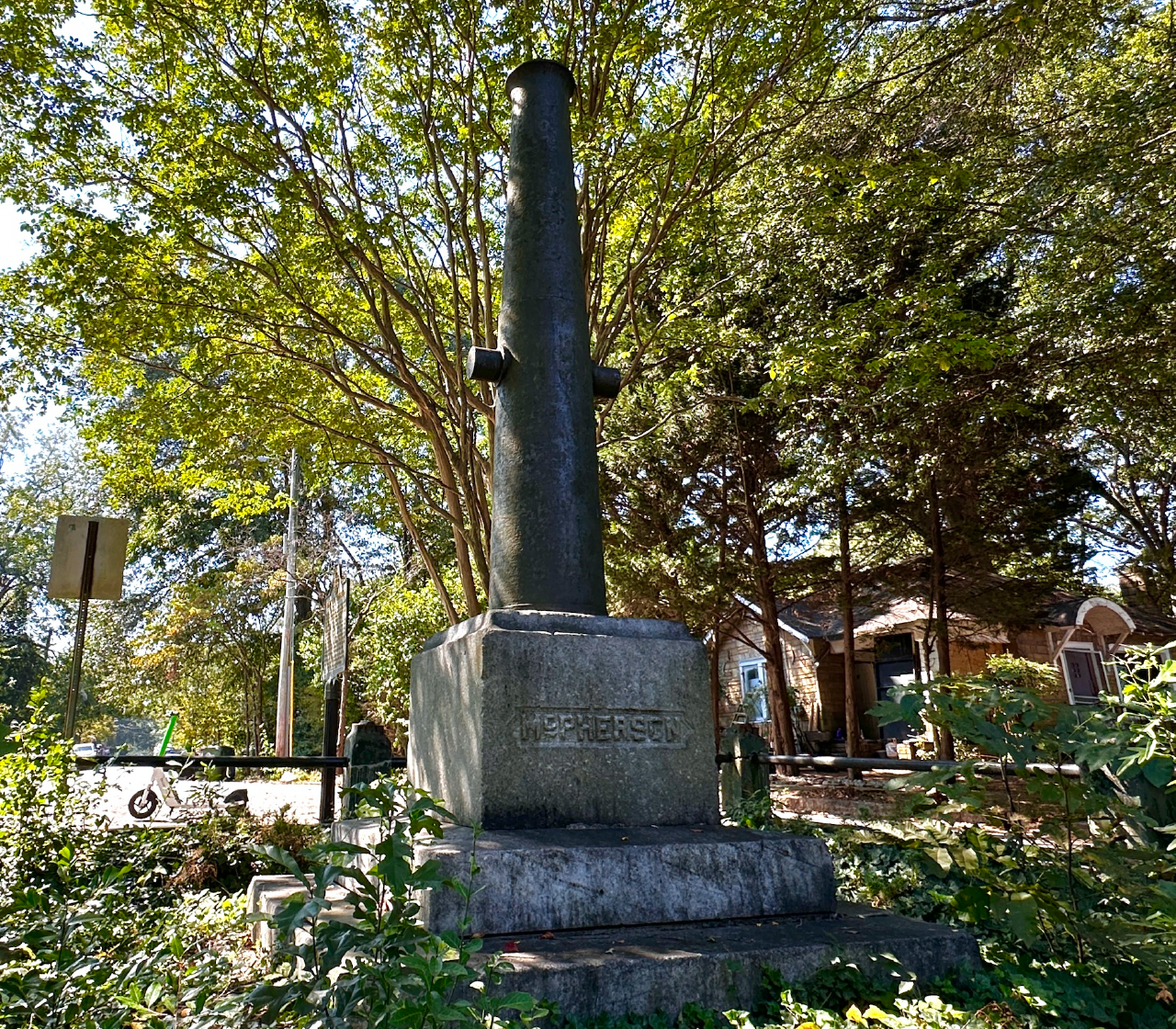
SITE
intersection of McPherson and Monument Avenue.
HISTORY

After the Union’s defeat at Kennesaw Mountain, McPherson had advanced his troops into Decatur, Georgia, and from there, they moved onto high ground on Bald Hill overlooking Atlanta. Sherman believed that the Confederates had been defeated and were evacuating; however, McPherson rightly believed that they were moving to attack the Union left and rear. On July 22, while they were discussing this new development, however, four Confederate divisions under Lt. Gen. William J. Hardee flanked Union Maj. Gen. Grenville Dodge's XVI Corps. While McPherson was riding his horse toward his old XVII Corps, a line of Confederate skirmishers appeared, yelling "Halt!". McPherson raised his hand to his head as if to remove his hat, but suddenly wheeled his horse, attempting to escape. The Confederates opened fire and mortally wounded McPherson in the back. When the Confederate troops approached and asked his orderly who the downed officer was, the aide replied "Sir, it is General McPherson. You have killed the best man in our army." This was early in the one-day Battle of Atlanta, part of the Atlanta campaign that led to the surrender of Atlanta a month later. General Otis Howard succeeded him as commander of the Army and Department of the Tennessee.
When Sherman received word of McPherson's death, he openly wept. He then penned a letter to Emily Hoffman in Baltimore, stating:
My Dear Young Lady, A letter from your Mother to General Barry on my Staff reminds me that I owe you heartfelt sympathy and a sacred duty of recording the fame of one of our Country's brightest and most glorious Characters. I yield to none on Earth but yourself the right to excel me in lamentations for our Dead Hero. Why should death's darts reach the young and brilliant instead of older men who could better have been spared?
Hoffman never recovered from his death, living a quiet and lonely life until her death in 1891.
Sherman declared in his official report:
His public enemies, even the men who directed the fatal shot, never spoke or wrote of him without expressions of marked respect; those whom he commanded loved him even to idolatry; and I, his associate and commander, fail in words adequate to express my opinion of his great worth. I feel assured that every patriot in America, on hearing this sad news, will feel a sense of personal loss, and the country generally will realize that we have lost, not only an able military leader, but a man who, had he survived, was qualified to heal the national strife which has been raised by designing and ambitious men.
