


Camp Jackson Interpretive Sign
N/A
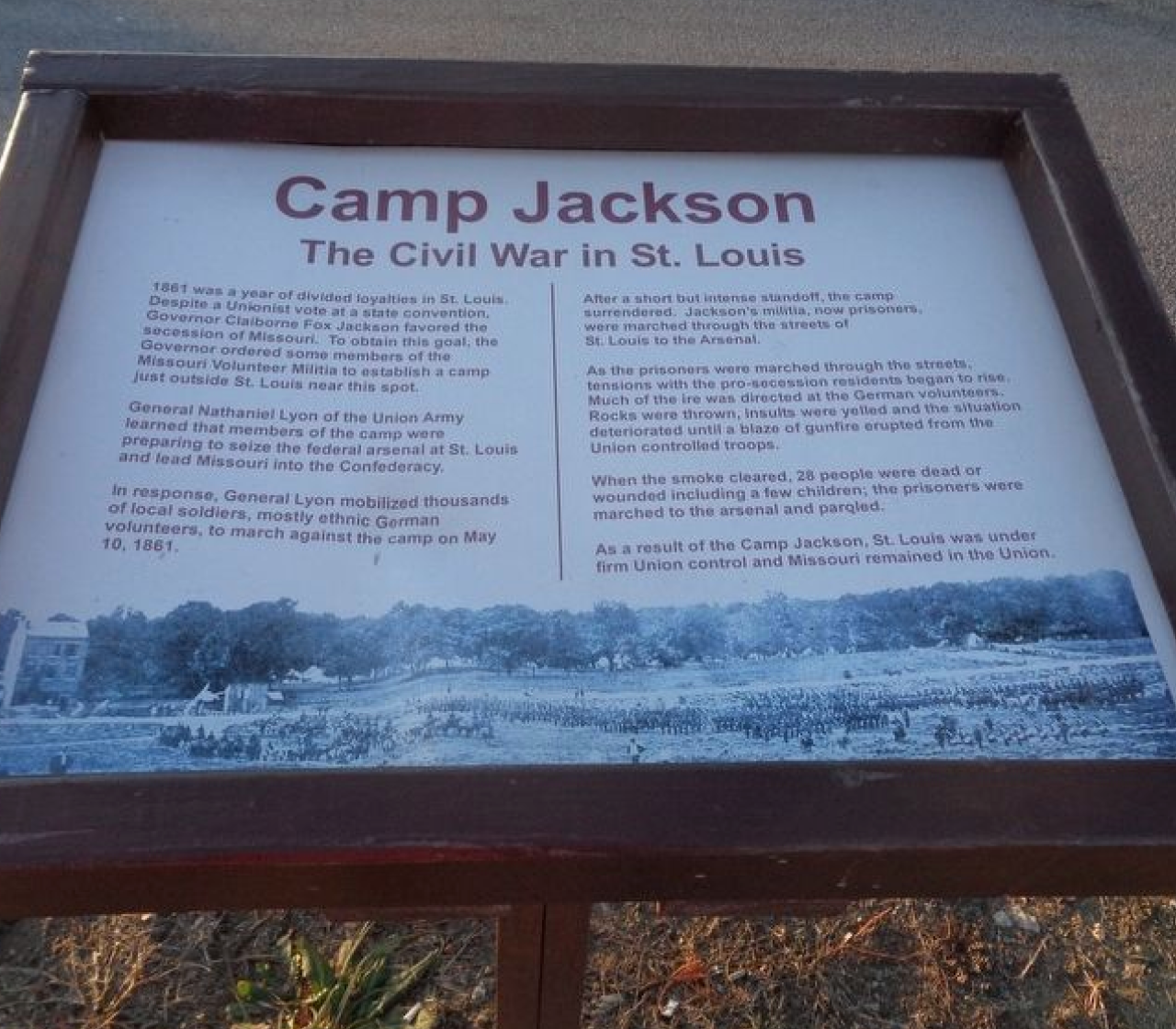
SITE
38° 38.083′ N, 90° 13.55′ W. Marker is in St. Louis, Missouri. It is in Midtown. It is on North Compton Avenue south of Olive Street, on the right when traveling north. Marker is in front of an open field (on the sidewalk) and across the street from a parking garage (on Saint Louis University campus).
HISTORY

William T. Sherman was present in St. Louis when many of the key events of 1861 in Missouri took place.
Sherman remembered the situation in his memoirs:
The whole air was full of wars and rumors of wars. The struggle was going on politically for the border States. Even in Missouri, which was a slave State, it was manifest that the Governor of the State, Claiborne Jackson, and all the leading politicians, were for the South in case of a war. The house on the northwest corner of Fifth and Pine was the rebel headquarters, where the rebel flag was hung publicly, and the crowds about the Planters' House were all more or less rebel. There was also a camp in Lindell's Grove, at the end of Olive Street, under command of General D. M. Frost, a Northern man, a graduate of "West Point, in open sympathy with the Southern leaders. This camp was nominally a State camp of instruction, but, beyond doubt, was in the interest of the Southern cause, designed to be used against the national authority in the event of the General Government's attempting to coerce the Southern Confederacy.
On May 9th, Sherman would take his children with him to visit the St. Louis Arsenal and described the scene that day:
Within the arsenal wall were drawn up in parallel lines four regiments of the “Home Guards,” and I saw men distributing cartridges to the boxes. I also saw General Lyon running about with his hair in the wind, his pockets full of papers, wild and irregular, but I knew him to be a man of vehement purpose and of determined action. I saw of course that it meant business, but whether for defense or offense I did not know.
The next day, Sherman, along with his son Willie, followed the crowds up to Lindell Grove and was a witness to the Camp Jackson Affair:
[That] morning I . . . heard at every corner of the streets that the "Dutch" were moving on Camp Jackson. People were barricading their houses, and men were running in that direction . . . I felt as much interest as anybody else, but staid at home, took my little son Willie, who was about seven years old, and walked up and down the pavement in front of our house, listening for the sound of musketry or cannon in the direction of Camp Jackson . . . Edging gradually up the street, I was in Olive Street just about Twelfth, when I saw a man running from the direction of Camp Jackson at full speed, calling, as he went, “They've surrendered, they've surrendered!”
A crowd of people was gathered around, calling to the prisoners by name, some hurrahing for Jeff Davis, and others encouraging the troops . . . The man had in his hand a small pistol, which he fired off, and I heard that the ball had struck the leg of one of Osterhaus's staff; the regiment stopped; there was a moment of confusion, when the soldiers of that regiment began to fire over our heads in the grove. I heard the balls cutting the leaves above our heads, and saw several men and women running in all directions, some of whom were wounded. Of course there was a general stampede. Charles Ewing threw Willie on the ground and covered him with his body. Hunter ran behind the hill, and I also threw myself on the ground. The fire ran back from the head of the regiment toward its rear, and as I saw the men reloading their pieces, I jerked Willie up, ran back with him into a gulley which covered us, lay there until I saw that the fire had ceased, and that the column was again moving on, when I took up Willie and started back for home round by way of Market Street.